

Australia’s commercial poultry industry has earned an international reputation for maintaining some of the highest biosecurity standards in the world. Those standards have helped protect producers, safeguard food supplies and support an industry worth billions of dollars each year.
However, biosecurity is never static.
As the global spread of Highly Pathogenic Avian Influenza (HPAI), commonly known as bird flu, continues to evolve, Australian poultry producers are once again reviewing every aspect of their biosecurity programs. The recent detection of the H5N1 strain in wild birds has heightened awareness across the industry and reinforced a simple truth: prevention is always better than response.
For many producers, biosecurity means disinfectant stations, controlled access points, protective clothing and vehicle wash-down facilities. These remain essential components of every commercial poultry operation.
Yet one area is often underestimated, the movement of people.
Employees, contractors, veterinarians, maintenance technicians and managers travel between farms every day. Every movement has the potential to introduce risk if it is not properly managed.
In this article, we’ll examine Australia’s current bird flu situation, explore why people movement deserves greater attention within modern poultry farm biosecurity, and share how one large Queensland poultry producer has strengthened its biosecurity program using digital workforce tracking.
Australia’s Current Bird Flu Situation
Highly Pathogenic Avian Influenza is not a new disease, but recent global outbreaks have demonstrated how quickly it can spread through wild bird populations and the devastating consequences it can have for commercial poultry enterprises.
The H5N1 strain has affected poultry industries across Europe, North America, South America and parts of Asia. Millions of birds have been culled worldwide as authorities have worked to contain outbreaks and protect commercial production.
Australia has remained in a comparatively strong position thanks to stringent biosecurity measures and active surveillance programs. However, the detection of H5N1 in wild birds has increased the importance of maintaining robust on-farm biosecurity.
Government agencies continue to encourage poultry producers to:
- Restrict unnecessary movement onto poultry properties.
- Monitor flocks for signs of illness.
- Report unusual bird deaths immediately.
- Maintain strict hygiene procedures.
- Record visitors and contractor movements.
- Review and update biosecurity plans regularly.
The message is clear: every layer of protection matters.
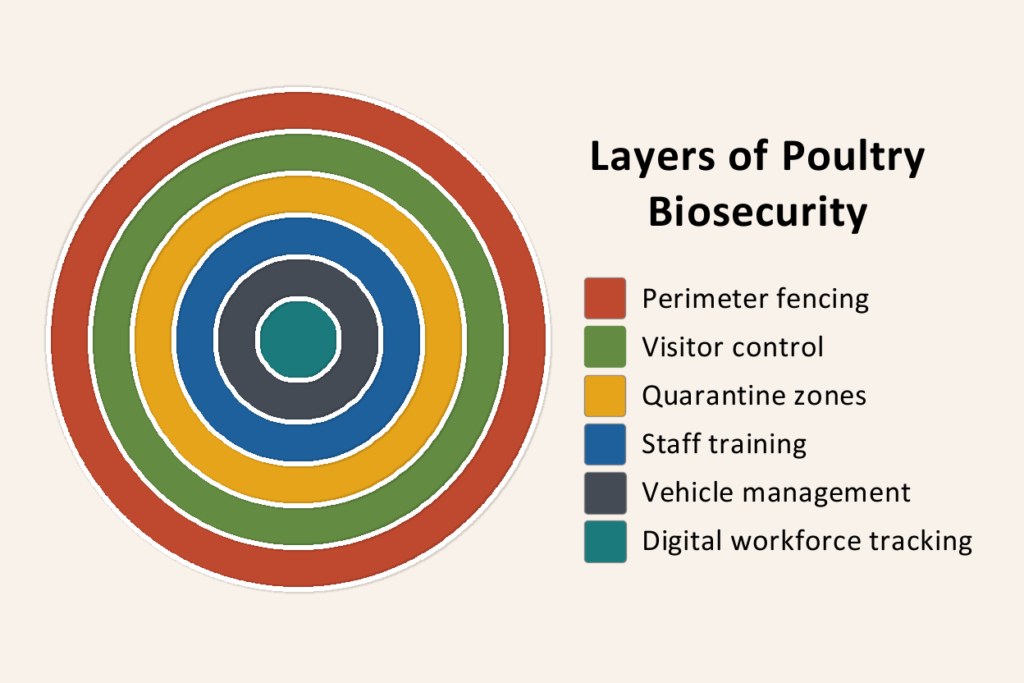
Biosecurity Is Built on Layers
There is no single solution that prevents disease.
Instead, successful poultry farm biosecurity relies on multiple layers of protection working together.
These typically include:
- Secure site boundaries.
- Controlled entry points.
- Protective clothing and footwear.
- Equipment cleaning and disinfection.
- Vehicle wash-down procedures.
- Wildlife and pest control.
- Staff education and training.
- Visitor management.
- Accurate record keeping.
- Movement controls.
Each measure reduces risk.
Together, they create a resilient biosecurity system.
When one layer fails, the others continue providing protection.
This “multiple layers” approach has become recognised internationally as one of the most effective ways to reduce the likelihood of disease entering commercial poultry operations.
Why People Movement Is an Overlooked Biosecurity Risk
Many poultry businesses have invested heavily in managing vehicle movements and equipment hygiene.
Ironically, the people moving between those same locations often receive far less attention.
Consider a typical commercial poultry business.
- An area manager visits four farms before lunch.
- A maintenance technician repairs equipment at two breeder facilities and then attends a broiler farm.
- A veterinarian inspects birds across several production sites.
- Contractors complete scheduled maintenance throughout the week.
Every one of these movements has the potential to transfer contamination if established biosecurity procedures are not followed.
The challenge becomes even greater for organisations operating multiple farms across different geographic regions.
Without accurate records, important questions become difficult to answer.
- Who entered each site today?
- Which farms has that contractor visited this week?
- Has anyone moved directly from a higher-risk quarantine area into a lower-risk production site?
- Who needs to be contacted if an investigation becomes necessary?
These questions may seem administrative during normal operations.
During a biosecurity incident, they become critical.
The Importance of Quarantine Zones
Most commercial poultry businesses divide their operations into biosecurity zones.
These zones may separate breeder farms from broiler farms, distinguish production areas from administration facilities or identify locations requiring different levels of disease control.
- Each zone has specific access requirements.
- Some areas require changing clothing.
- Others require shower-in and shower-out procedures.
- Some locations prohibit visitors altogether.
The effectiveness of these quarantine zones depends not only on physical barriers but also on ensuring people follow the required movement protocols.
If someone unintentionally moves from a higher-risk area into a lower-risk site without following established procedures, the integrity of the entire system can be compromised.
Managing these movements consistently across dozens of farms and hundreds of employees presents a significant operational challenge.
Why Paper Sign-In Books Have Limitations
For many years, paper visitor books have been the industry standard.
They remain useful for recording basic site attendance, but they have clear limitations when organisations need to understand workforce movements across multiple locations.
Paper records can be:
- Difficult to read.
- Incomplete.
- Time-consuming to search.
- Stored at individual sites rather than centrally.
- Challenging to analyse during investigations.
If an organisation needs to identify everyone who visited three different farms over the previous fortnight, paper records may require hours of manual review.
Digital records provide a different level of visibility.
Managers can quickly identify historical movements, review access history and produce reports when required.
This does not replace good biosecurity procedures it simply makes them easier to monitor and verify.
Modern Poultry Biosecurity Requires Better Information
Technology cannot prevent disease.
People and procedures remain the foundation of every successful biosecurity program.
However, technology can provide better information to support those procedures.
Digital workforce tracking enables organisations to answer questions that previously required extensive manual investigation.
For example:
- Which authorised workers entered Site A yesterday?
- Has this contractor already visited another poultry facility today?
- What was the sequence of site visits?
- Are staff following approved movement protocols?
- Can we quickly produce an audit trail if required?
Having immediate access to accurate information improves decision-making during both routine operations and potential biosecurity events.
Case Study: Supporting Biosecurity Through Workforce Visibility
One large commercial poultry producer in Queensland recognised that workforce movement across multiple production sites was becoming increasingly complex.
The business operates numerous poultry facilities with employees, contractors and operational staff travelling between locations every day.
While strong biosecurity procedures were already in place, management wanted greater visibility of workforce movements to support compliance with quarantine protocols and strengthen operational traceability.
To achieve this, the organisation implemented EMP Track, a digital workforce tracking system developed by Deltonic Pty Ltd t/a ValuTronics.
EMP Track records when authorised personnel enter and leave each site, creating an accurate digital history of workforce movements across the operation.
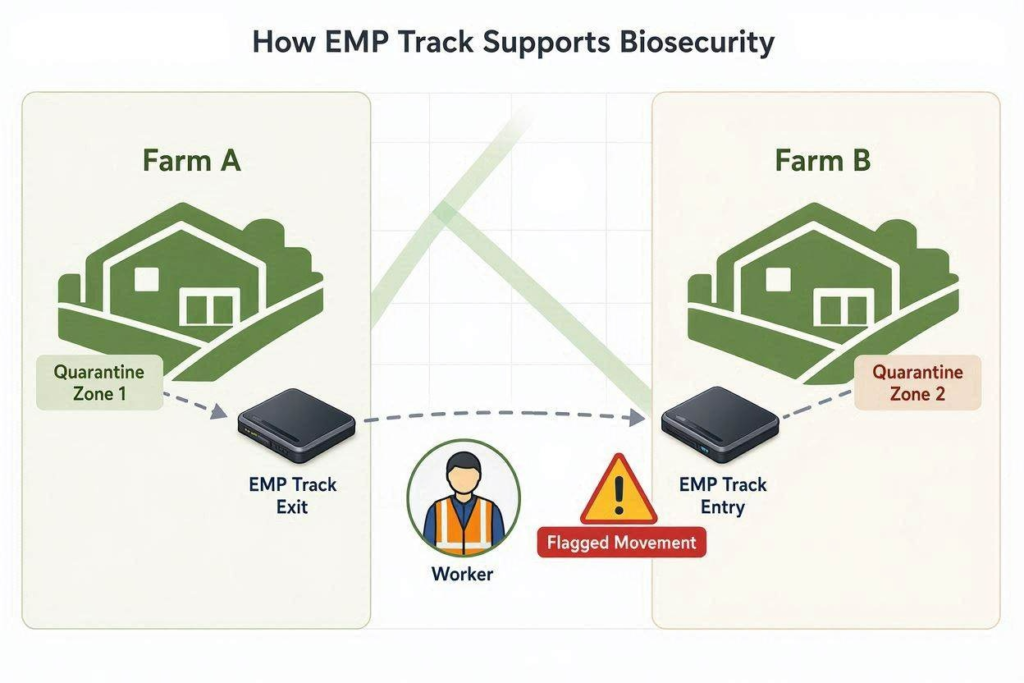
Importantly, the system enables management to monitor movement between locations with different quarantine classifications.
This visibility helps reduce the likelihood of personnel inadvertently entering lower-risk production areas after visiting higher-risk locations without following established biosecurity procedures.
Rather than replacing existing farm biosecurity measures, the system complements them by providing accurate, searchable records that support compliance and improve operational oversight.
The poultry producer now has a reliable digital audit trail showing where authorised workers have been, when they attended each site and how workforce movements align with the organisation’s biosecurity protocols.
Lessons for Commercial Poultry Producers
- Every poultry operation is different.
- Some producers manage a single family-owned farm.
- Others oversee dozens of production facilities across multiple regions.
- Regardless of size, several principles remain consistent.
- Review biosecurity regularly. Disease threats change over time, and biosecurity plans should evolve with them.
- Don’t overlook people movement. Employees, contractors and visitors all play an important role in maintaining biosecurity.
- Invest in staff training. Procedures only work when everyone understands why they exist.
- Maintain accurate records. Good record keeping supports audits, investigations and continual improvement.
- Use technology where it adds value. Digital systems should strengthen existing processes rather than replace good management practices.
Looking Ahead
Australia’s poultry industry has built a strong international reputation through decades of commitment to biosecurity.
Maintaining that reputation will require continued investment in practical procedures, staff education and technologies that improve operational visibility.
As producers prepare for emerging disease risks such as H5N1, understanding the movement of people between production sites is becoming an increasingly important component of commercial poultry biosecurity.
Knowing who has been where, and when, is no longer simply an administrative exercise. It is part of building a resilient, traceable and well-managed poultry operation.
For organisations managing multiple farms, digital workforce tracking provides another valuable layer of information that supports existing biosecurity measures and helps ensure movement protocols are consistently followed.
About EMP Track
EMP Track is a workforce tracking and site access solution developed by ValuTronics. It provides organisations with accurate digital records of authorised personnel movements across multiple sites, helping improve operational visibility, compliance and traceability.
Within the poultry industry, EMP Track has proven particularly valuable in supporting biosecurity programs by recording staff movements between sites with different quarantine classifications and providing managers with a searchable audit trail of workforce activity.
Trusted Biosecurity Resources for Australian Poultry Producers
To stay informed about avian influenza and best-practice biosecurity, we recommend regularly consulting these authoritative sources:
- Australian Government – Bird Flu (H5) Information
- Department of Agriculture, Fisheries and Forestry – Avian Influenza
- Wildlife Health Australia
- Queensland Department of Primary Industries
- Australian Veterinary Association
These organisations provide current advice, surveillance updates and practical guidance to help producers protect Australia’s poultry industry.
About ValuTronics
At ValuTronics, we work with organisations operating in highly regulated and safety-critical environments to improve workforce visibility, site access management and operational compliance.
If you’d like to learn more about how EMP Track supports workforce traceability within commercial poultry operations, we’d be happy to discuss your requirements.